
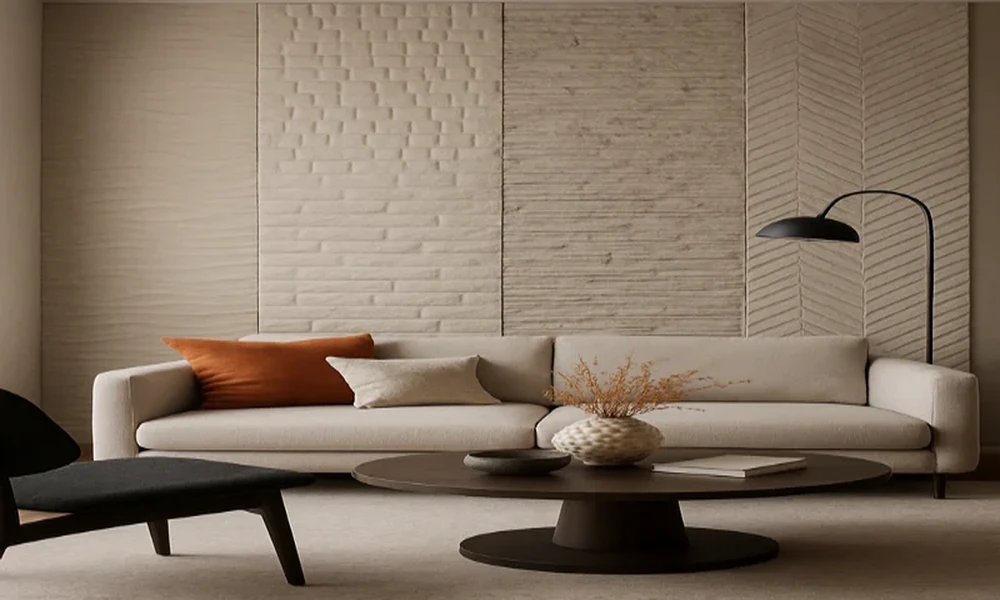

Textured wall panels change the way light moves across an interior. Grooves, ridges and shaped surfaces create highlights and shadows that a flat painted wall cannot produce in the same way. This makes lighting part of the material choice, rather than a finishing detail added after installation. By testing a sample in the intended room and considering both daylight and lamps, homeowners can create a feature that remains attractive throughout the day and useful when the room is occupied.
Look at the light already in the room
Before choosing fittings, watch the proposed wall over the course of a day. Notice whether sunlight strikes it from the side, whether nearby buildings block the window and whether the surface stays in shadow. The same panel can appear sharply defined in direct light and softer under an overcast sky.
Take photographs from the usual viewing positions, but also rely on what you see in person. Cameras adjust brightness automatically and may exaggerate or flatten contrast. A sample on the actual wall gives a more reliable impression than a product image. Move it between likely locations if you have not yet chosen the feature area.
Understand the direction of the light
Light travelling across a textured surface tends to reveal its relief. Light coming from close to the viewer’s position can make the same surface appear flatter. Neither effect is automatically better. A strongly modelled wall suits a focal point, while softer lighting may be more comfortable behind a desk or beside a television.
Try a portable lamp before committing to a permanent fitting. Change its angle and distance, and watch how the shadows behave. Very close light can reveal small surface irregularities and panel joints. This is useful during planning because it shows where preparation and installation quality will be especially visible.
Relate the fitting to the profile
A broad fluted profile creates a different shadow pattern from closely spaced ribs or a sculpted three dimensional panel. Choose a fitting that complements the surface rather than expecting one arrangement to suit every material. A narrow beam can highlight a small feature, while a wider wash can create a calmer overall effect.
Think about the direction of the grooves as well. Vertical profiles work naturally with some tall wall lights, but a fitting does not need to repeat the pattern exactly. Judge the composition from across the room. The wall, furniture and lighting should form a coherent arrangement, with enough visual space around each element.
Check colour under the actual lamps
Colour temperature influences the appearance of both paint and timber. A finish that looks neutral in daylight may appear warmer beneath an evening lamp. Instead of choosing from colour names alone, view the panel sample under the fittings or bulbs you intend to use.
Consistency matters in adjoining areas. A hallway lit very differently from the room beyond can make a continuous paint colour appear mismatched. Consider the transition between spaces and test the finish from both sides of a doorway. Where possible, compare lighting choices before the panels are ordered and decorated, when adjustments are easier.
Keep decorative lighting useful
A wall feature should not leave the rest of the room poorly lit. Combine light that reveals texture with illumination suited to reading, working, cooking or moving safely through the space. The balance depends on the room and its occupants. A striking photograph is less useful than an arrangement that works comfortably every evening.
Avoid placing bright exposed sources where they reflect in a television or shine directly into seated eyes. Check the effect from the sofa, bed or desk as appropriate. If dimming is required, confirm that the fittings, drivers and controls are compatible. Electrical installation and changes to wiring should be handled by a qualified electrician.
Plan installation as one complete scheme
Mark the fitting positions, cable routes and panel boundaries before work starts. Decide how fittings will mount and how equipment remains accessible. Follow the installation requirements for the lighting system and the panel material, including relevant clearances. Decorative panels should not be treated as structural support for fittings without suitable backing.
For an example of coordinating texture with storage and circulation, explore this guide to fluted MDF panels in a hallway. A hallway makes the relationship particularly clear because the feature must share space with doors, mirrors and everyday movement.
Good lighting reveals a surface without overwhelming the room. Observe the daylight, test a representative sample, and position artificial light with the actual furniture in mind. When material and illumination are planned together, the texture can remain expressive in changing conditions while the room stays comfortable and practical.
How to Pair Textured Wall Panels with Everyday Lighting