
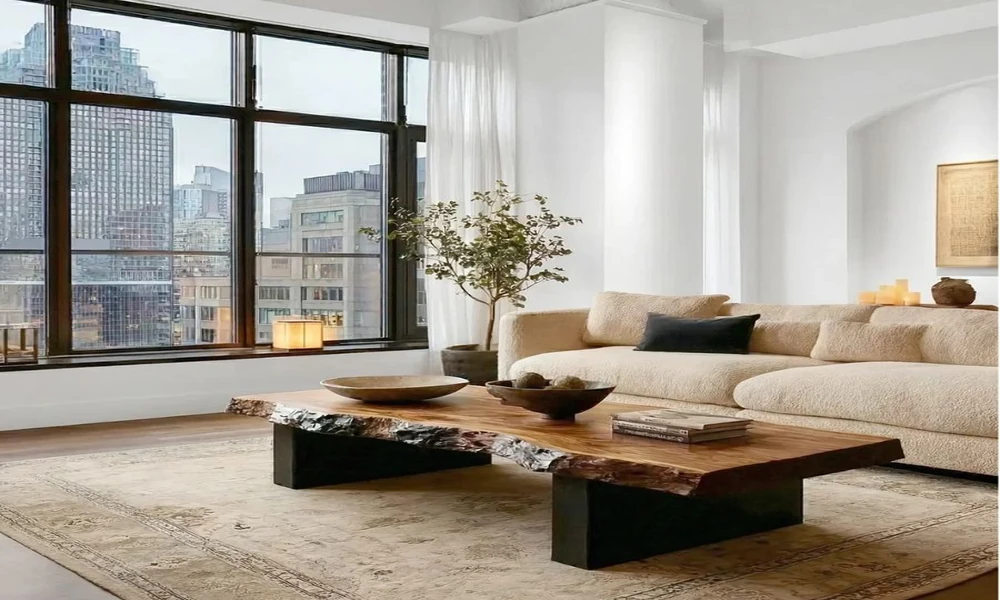

A living room can contain beautiful furniture and still feel uncomfortable if the pieces are not balanced.
A large sectional paired with tiny tables can look disproportionate. A small sofa surrounded by oversized furniture can feel visually overwhelmed. Even when every individual piece looks good, the overall arrangement may not work.
Furniture scale is therefore one of the most important elements of living room design.
The goal is not to make every item the same size. Instead, create a visual relationship between larger and smaller pieces so the room feels intentional and easy to use.
Start With the Largest Piece
In most living rooms, the sofa or sectional is the dominant piece.
Start there before selecting smaller furniture.
Measure its overall length, depth, and height. Then consider how much floor space remains for a coffee table, chairs, side tables, and walking paths.
A large sectional generally needs furniture with enough visual weight to balance it. A tiny coffee table can disappear in the middle of a substantial seating arrangement.
On the other hand, smaller furniture can be more appropriate in a compact room.
Avoid Filling Every Empty Area
An empty space is not necessarily a design problem.
Many people try to fill every corner of a living room because they feel the room looks unfinished. This can lead to too many chairs, tables, cabinets, and accessories.
Allowing some negative space gives larger furniture room to breathe.
It also improves movement through the room.
Before adding another piece, ask whether it serves a practical purpose or simply fills an empty spot.
Use the Coffee Table to Connect the Seating
The coffee table is often the visual bridge between the main seating pieces.
Its size should relate to the sofa while leaving enough room for people to move around it.
A larger seating arrangement can support a substantial table, while a compact sofa may need something lighter.
You can also use the table’s material to balance the room.
A live edge wood coffee table can introduce organic visual weight without requiring a bulky design. The natural shape and grain can give a simple seating arrangement a stronger focal point.
Create Variation in Height
Furniture does not need to sit at the same height.
In fact, variation often makes a room more interesting.
A low coffee table, medium-height sofa, tall floor lamp, and vertical bookcase create a more dynamic visual composition than several pieces with identical heights.
Think about the room from different viewpoints.
If everything sits low, the space may feel visually flat. If everything is tall, it may feel crowded.
Use different heights to guide the eye around the room.
Balance Visual Weight
Physical size is not the only factor.
Color, material, shape, and construction also influence how heavy a piece looks.
A dark, solid wood table can appear visually heavier than a light-colored table with thin legs even if both have similar dimensions.
Likewise, a large light-colored sofa may feel less dominant than a smaller dark sectional.
Consider visual weight when arranging furniture.
If one side of the room contains a substantial dark cabinet, you may want another strong element elsewhere to prevent the layout from feeling unbalanced.
Use Side Tables Strategically
Side tables are useful for creating smaller points of balance around a sofa or chair.
They do not need to match the coffee table.
In fact, using different but compatible materials can make the room feel more collected.
For example, a substantial wood coffee table can be paired with a smaller metal side table and a simple upholstered chair.
The different sizes prevent the furniture arrangement from looking like a matching set.
Pay Attention to Negative Space
The spaces between furniture pieces are just as important as the pieces themselves.
People need enough room to sit, stand, walk, and reach surfaces comfortably.
Do not judge the arrangement only from the front.
Walk through the room as if you were using it normally. Sit on the sofa. Stand up. Walk toward the door. Reach for the coffee table.
If the layout feels awkward in practice, change it before adding more furniture.
Consider the Size of the Room
A large room can accommodate multiple furniture groupings.
For example, you might create one main seating area around a coffee table and a separate reading corner with an armchair and floor lamp.
In a smaller living room, combining too many furniture zones can make the space feel fragmented.
Use the room’s actual dimensions as a guide rather than copying arrangements from large homes or furniture showrooms.
Use Rugs to Define Proportion
An area rug can visually connect several pieces of furniture.
A rug that is too small can make a large sofa and coffee table appear disconnected. A properly sized rug can make the entire seating arrangement feel like one cohesive zone.
The rug does not need to match the furniture exactly.
Its main purpose is to create a visual foundation.
For larger rooms, a generous rug can also help define where one furniture grouping ends and another begins.
Don’t Forget Vertical Space
Furniture balance is not only about the floor.
Walls, windows, shelves, artwork, curtains, and lighting all contribute to the room’s overall proportions.
If all the furniture sits low while the walls are completely empty, the room can feel visually bottom-heavy.
A tall floor lamp, artwork, bookcase, or plant can help draw attention upward.
This is especially useful when the room has high ceilings.
Use One Strong Focal Point
Every living room benefits from something that naturally attracts attention.
It could be a fireplace, large window, artwork, sofa, or coffee table.
Once you identify the focal point, arrange the other furniture so it supports rather than competes with that element.
A distinctive wood table can be an effective focal point in a relatively simple room because the natural grain provides visual interest without requiring bold colors.
Make the Room Feel Intentional
Good furniture balance is less about following strict measurements and more about relationships.
Large pieces should have enough space around them. Smaller pieces should support the main furniture rather than disappear. Heights should vary, visual weight should be distributed, and circulation should remain comfortable.
The goal is a room that feels naturally organized.
Tailor Wood Haven creates handcrafted furniture where natural wood character can provide a strong visual element without relying on excessive decoration. A distinctive coffee table can help anchor a seating arrangement while still leaving the rest of the room relatively simple.
When furniture is chosen according to scale, proportion, and everyday use, even a mix of different pieces can feel cohesive.
Contact Information:
- Website: https://tailorwoodhaven.com/
- Email: hello@tailorwoodhaven.com