
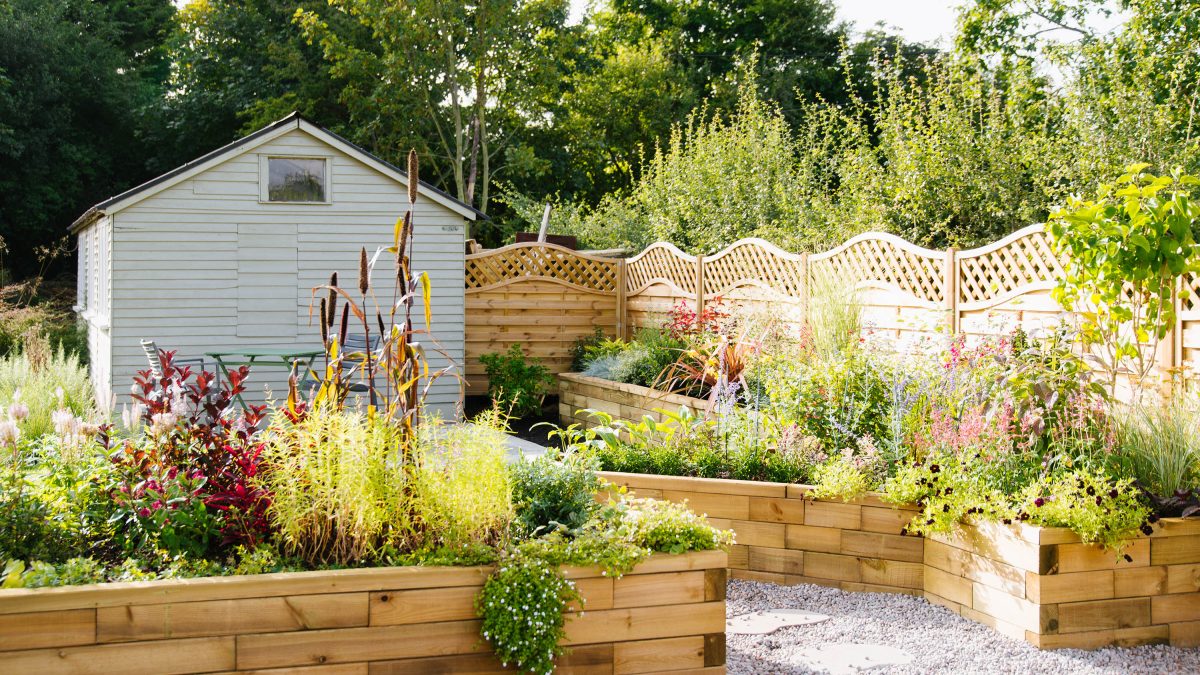

The low-maintenance garden has become one of the biggest shifts I’ve noticed in what homeowners expect from their outdoor space. People still want somewhere pleasant to sit, entertain and let the children play, but fewer want to spend every weekend painting, pruning, mowing and repairing it. The irony is that some supposedly low-maintenance gardens still have one very high-maintenance feature running around the entire perimeter. Choosing the right garden fencing matters just as much as choosing easy-care paving, planting or decking if the aim is genuinely to reduce the workload.
I understand the appeal.
Gardens have changed. For many households, they are no longer primarily gardening projects. They are usable spaces.
People want somewhere they can put a table, have a barbecue, kick a football around or sit outside after work. If maintaining the garden starts to feel like another job, it rather defeats the purpose.
But “low maintenance” is one of those phrases that can hide quite a lot.
There is no such thing as a completely maintenance-free garden, and there certainly isn’t a completely maintenance-free boundary.
The sensible aim is to choose materials and construction methods that reduce unnecessary work and avoid predictable problems.
A fence is a much bigger part of the garden than people realise
Imagine a fairly ordinary back garden with fencing along three sides.
There might be 20, 30 or 40 metres of boundary. Depending on the fence height, that represents a considerable surface area exposed to rain, sunlight, wind, frost, vegetation and ground moisture every day of the year.
Yet boundaries are often one of the last things considered during a garden redesign.
People will spend weeks deciding between paving slabs. They’ll compare decking colours. They’ll carefully position raised beds and outdoor furniture.
The fence sometimes gets whatever money is left.
That can be a costly way of doing things.
A tired boundary affects the appearance of everything in front of it, while an unstable one can eventually mean dismantling or disturbing parts of a newly finished garden to put the problem right.
I’ve worked on gardens where access to an old fence post has become unnecessarily difficult because expensive paving, raised beds or permanent structures were installed around fencing that was already nearing the end of its life.
If you’re spending serious money making a garden easier to live with, look at the boundary before everything else gets built around it.
Low maintenance starts below ground
This isn’t the glamorous part of fencing, but it is probably the most important.
You can reduce painting. You can choose materials that don’t rot. You can select panels that are easy to replace.
None of that compensates for unstable posts.
A surprising amount of fence maintenance begins with movement rather than deterioration of the visible fence itself.
Once a post starts leaning, panels can become loose. Rails come under stress. Gates stop lining up. Fixings work themselves free. What initially looks like several separate maintenance problems can actually originate from one unstable support.
Ground conditions therefore matter.
Around Barnsley and elsewhere in South Yorkshire, you can encounter everything from heavy, moisture-retaining ground to gardens containing rubble and remnants of previous landscaping or construction. Older properties can be particularly interesting once you start digging.
I’ve found old concrete, bricks, previous post footings and all sorts buried exactly where the new post needs to go.
That is fencing.
The neat photograph at the end doesn’t show the difficult bit underneath it.
A properly considered post installation reduces the likelihood that you’ll be returning every few years to straighten, brace or replace parts of the boundary.
Timber isn’t automatically high maintenance
There is sometimes a tendency to describe timber fencing as though it needs constant attention.
It doesn’t.
Good-quality treated timber, correctly installed and kept away from unnecessary sources of persistent moisture, can give long service.
The problems tend to appear when timber is expected to tolerate conditions it was never well protected against.
The ground line is particularly important with timber posts. This is where I often find deterioration on older fencing. The visible section of the post can look reasonably healthy while the timber around or just below ground level has softened considerably.
This is one reason concrete posts and gravel boards are popular in gardens where owners want to reduce ongoing maintenance.
The gravel board keeps the timber panel away from direct ground contact, while the concrete post removes the vulnerable timber post from the equation.
It doesn’t mean the fence will last forever.
Panels still age. Fixings still need checking. Concrete can occasionally crack or move.
But replacing an individual timber panel between sound concrete posts is generally a much simpler proposition than rebuilding a fence whose structural posts have failed.
Composite solves some problems, not every problem
It is easy to see why composite materials appeal to homeowners creating lower-maintenance gardens.
They don’t require the same painting or staining routine associated with decorative timber treatments, and they can provide a clean, consistent appearance.
For the right garden, composite fencing makes a lot of sense.
What I wouldn’t do is describe it as maintenance-free.
Nothing outdoors deserves that description.
Composite fencing still gets dirty. Algae and general grime can appear, particularly in shaded areas. Plants grow against it. Fixings and supporting structures still matter. Gates and moving components still need attention.
Most importantly, composite doesn’t repeal the laws of physics.
A premium fence installed on inadequate supports is still a badly installed fence.
I’ve always considered that distinction more important than the material itself.
People sometimes become so focused on choosing the supposedly longest-lasting board or panel that they pay less attention to how the complete fence will be constructed.
Posts, spacing, ground conditions and exposure matter regardless of what goes between them.
Think about what is touching the fence
One of the simplest ways to reduce fence maintenance costs is to stop making the fence do jobs it wasn’t designed to do.
Heavy vegetation is a common example.
There is nothing wrong with growing plants around a boundary. In many gardens, fencing and planting look better together than either would independently.
Problems start when mature shrubs, climbers or hedges are allowed to push continuously against panels.
Vegetation holds moisture. It can restrict airflow around timber and make inspection difficult. Large plants can also put considerable physical pressure on fencing, particularly once they become wet or catch strong winds.
I’ve seen fences that appeared perfectly reasonable from one side but were in poor condition behind dense growth.
By the time the problem was visible, several relatively minor defects had become one much larger repair.
Leave enough access to inspect the boundary.
You don’t need a sterile strip around the garden, but you should be able to see what is happening.
Be careful with the word “maintenance-free”
It sells products wonderfully.
It doesn’t describe gardens particularly well.
Even concrete fencing benefits from occasional inspection. Composite needs cleaning. Metal components can need adjustment. Gates contain moving parts. Timber changes with moisture. Soil moves. Plants grow.
The better question isn’t, “What never needs maintenance?”
It is, “What type of maintenance am I willing to do?”
Some homeowners are perfectly happy treating timber every few years because they prefer its appearance.
Others would rather clean composite occasionally and avoid painting.
Some want concrete posts because replacing individual panels later is straightforward.
Others don’t like the appearance of concrete and prefer timber throughout.
Those are all reasonable positions.
A low-maintenance garden doesn’t have to look like everybody else’s low-maintenance garden.
Gates deserve separate thought
I would never assume that because a boundary is low maintenance, the gate will be too.
A gate behaves differently from a fence panel.
It moves.
Its weight hangs from one side. Hinges carry repeated loads. The supporting post has to resist leverage every time the gate opens and closes. Latches need to remain aligned.
A slight amount of post movement that would barely be noticeable elsewhere in the fence can become irritating very quickly beside a gate.
Suddenly it drags.
Then somebody adjusts the hinges.
A few months later it drags again.
If that happens repeatedly, look beyond the gate itself. The supporting post may be moving.
Good garden gates depend as much on their supports and hardware as the material used to make the gate.
This becomes particularly important with larger and heavier gates.
Repairability is part of low maintenance
This is something I think gets overlooked.
People often judge maintenance requirements by asking how frequently something is likely to go wrong.
I also ask how difficult it will be to put right when it eventually does.
Every outdoor structure will need attention at some point.
A fence designed so that individual components can be repaired or replaced can be much easier to own over 15 or 20 years than something that requires substantial dismantling whenever one section develops a problem.
That is why I like systems where damaged components can be dealt with individually where practical.
If one panel has been damaged by a falling branch, replacing one panel makes sense.
If a single post has failed but the rest of the structure remains sound, a targeted repair may make sense.
If a gate needs adjustment after years of use, adjust it.
Low maintenance shouldn’t mean throwing away an entire structure because one component has deteriorated.
Don’t design today’s garden around tomorrow’s access problem
This is particularly relevant when gardens are being renovated.
Think about how somebody would repair the fence in ten years.
Can the posts still be reached?
Could a panel actually be removed?
Has a shed been positioned millimetres away from the boundary?
Are raised beds fixed directly against it?
Has decking been constructed around timber posts that will eventually need replacing?
These things sound trivial during a garden redesign because the new fence looks perfect.
Ten years later, they aren’t trivial at all.
I’ve had jobs where repairing the fencing was the easy part. Reaching it without damaging everything somebody had subsequently built around it was considerably harder.
A little thought about future access can prevent a lot of unnecessary labour.
The best low-maintenance fence is usually a boringly well-built one
There is always another product promising longer life, less cleaning or fewer repairs.
Some of those products are excellent.
But after enough years working with fencing, I’ve become less interested in dramatic claims and more interested in the basics.
Is the fence suitable for the site?
Are the posts appropriate?
Are they installed properly?
Is timber protected from unnecessary ground contact?
Can water drain?
Is the boundary excessively exposed to wind?
Are the fixings suitable?
Can individual parts be repaired later?
Get those decisions right and maintenance usually becomes manageable.
Get them wrong and even an expensive “low-maintenance” fence can become surprisingly demanding.
The easiest gardens to look after aren’t necessarily filled with the newest materials. They’re usually the ones where somebody thought carefully about how every part of the garden would age before they built it.